The AI Operating Model Design Guide

Govern, fund, and scale AI as an enterprise capability, not a collection of projects.

Most organisations do not fail at AI because the model is weak. They fail because the operating system around AI is missing: who decides, what gets funded, how risk is governed, when a pilot earns production, and who owns the capability after the AI team moves on.

This decision aid gives senior leaders the shape of the operating model: the structural choices, decision rights, stage gates, and ownership moves required to turn AI from scattered initiatives into governed production.

Built from patterns I have seen across enterprise AI, product leadership, operator care, and transformation work. Illustrated through ArNa Assure, a fictional composite European insurer.

AI scale is not a model problem first. It is an operating model problem.
Framework 01 Decision aid Five minute read Full PDF operating tool available on request
The operating model at a glance

AI scale as a management system, not a project funnel.

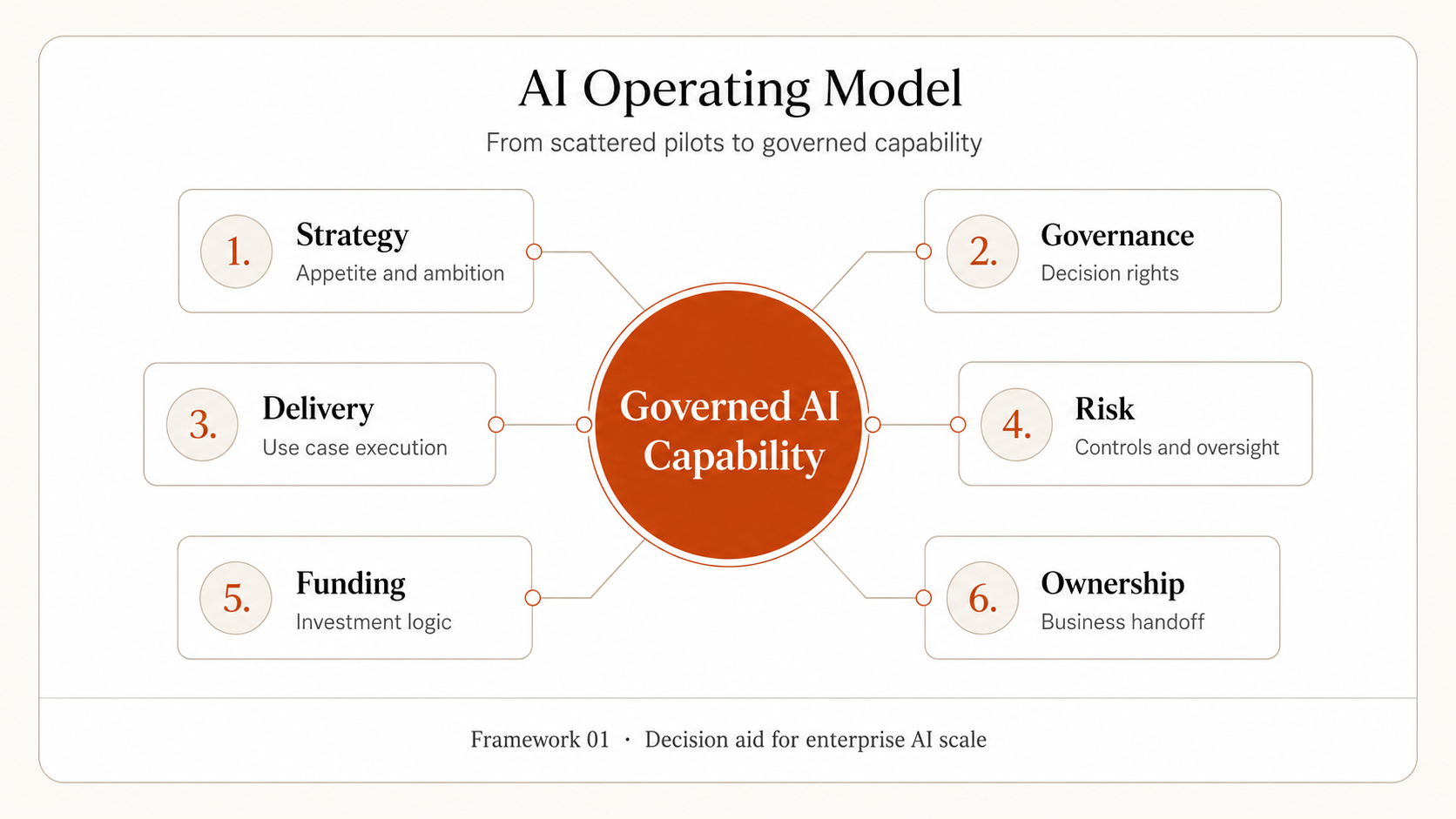
The framework that follows is the executive shape of the operating model: how strategy, governance, delivery, risk, funding, and ownership connect into one system that moves AI from experimentation to governed production.

Executive operating model map showing how strategy, governance, delivery, risk, funding, and ownership connect into one AI operating system
The full operating model connects ambition, governance, delivery, funding, and ownership into one management system.
Operating model diagnostic

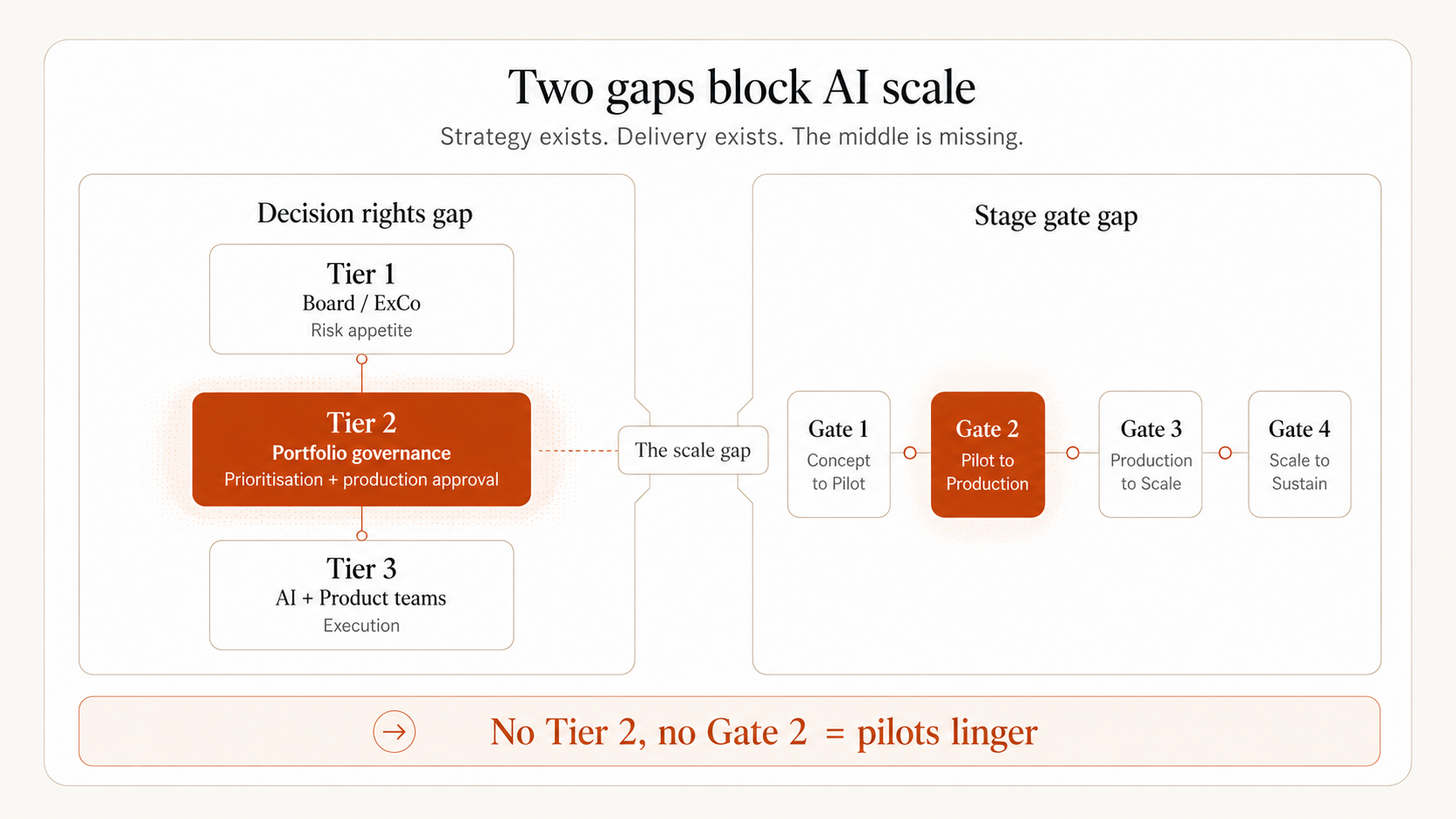
Two structural gaps quietly kill enterprise AI.

In many organisations, AI strategy exists at the top and AI delivery exists at the bottom. The missing layer is the one that turns ambition into portfolio choices, risk criteria, production decisions, and ownership transfer.

The first gap is Tier 2. Tier 1 is the Board or ExCo, setting ambition, risk appetite, and investment thresholds. Tier 3 is the AI, product, data, and engineering teams doing the work. Tier 2 is the portfolio governance body that decides which use cases move forward, what evidence is required, and when a pilot is allowed into production.

The second gap is Gate 2. Most organisations can move from concept to pilot. Far fewer have a formal decision point for moving from pilot to production. Without Gate 2, pilots do not scale. They linger.

If the ExCo approves production, the decision is probably too slow. If the AI team approves production, the decision is probably not independent enough.
The Tier 2 and Gate 2 diagnostic — two structural gaps that stop AI moving from ambition and pilots into governed production
Tier 2 and Gate 2 are the two missing mechanisms that most often separate AI experimentation from governed production.
The leadership agenda

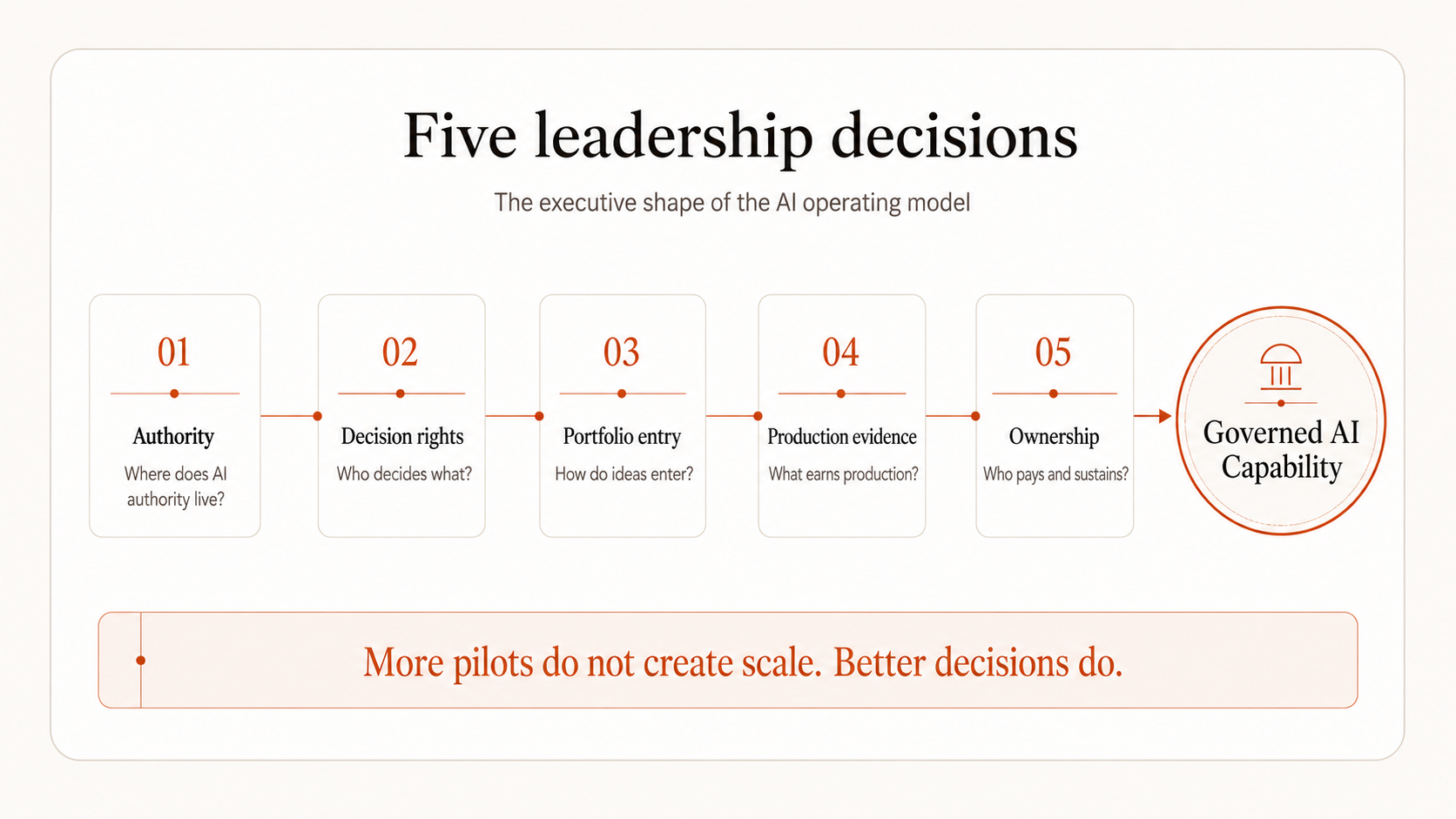
The framework reduces AI scale to five decisions.

An AI operating model does not begin with another pilot. It begins with five leadership decisions.

First, where authority for AI lives. Is AI centralised, hub and spoke, federated, or embedded?

Second, who decides what. Which decisions belong to the ExCo, which belong to portfolio governance, and which belong to delivery teams?

Third, how ideas enter the portfolio. AI demand needs a route into the system, not a louder sponsor or a better demo.

Fourth, what must be true before production. A pilot should move forward because it has met evidence-based criteria, not because the team believes it is promising.

Fifth, who pays, owns, and sustains the capability. Funding design determines whether the business becomes accountable for outcomes or simply consumes central AI capacity.

The model is rarely the missing piece. The missing piece is the operating system around the model.
Five leadership decisions that convert AI from project activity into governed capability
The five decisions that convert AI from project activity into enterprise capability.
Structural choice

Design for the maturity you have, not the maturity you want.

Every AI operating model sits on a spectrum of centralisation. The mistake is not choosing an imperfect model. The mistake is choosing a model the organisation is not mature enough to operate.

A centralised model works when capability is still scarce and consistency matters more than domain speed. The risk is bottlenecking.

A hub-and-spoke model gives the centre ownership of platform, standards, governance, enablement, and scarce talent, while business domains own use case delivery. This is often the strongest target model for mid- to large enterprises moving from experimentation to scale.

A federated model works when business domains are mature enough to build responsibly within central guardrails. The risk is fragmentation.

An embedded model only works when AI is already a mature organisational capability. Adopted too early, it creates invisible governance gaps.

Do not jump to the model leadership admires. Build the model the organisation can operate now, with a deliberate path to the next stage.
Operating archetype progression — centralised, hub-and-spoke, federated, and embedded as a maturity-aligned progression
The four archetypes show where authority can sit as AI capability matures.
Operational machinery

Gate 2 is where most AI programmes break.

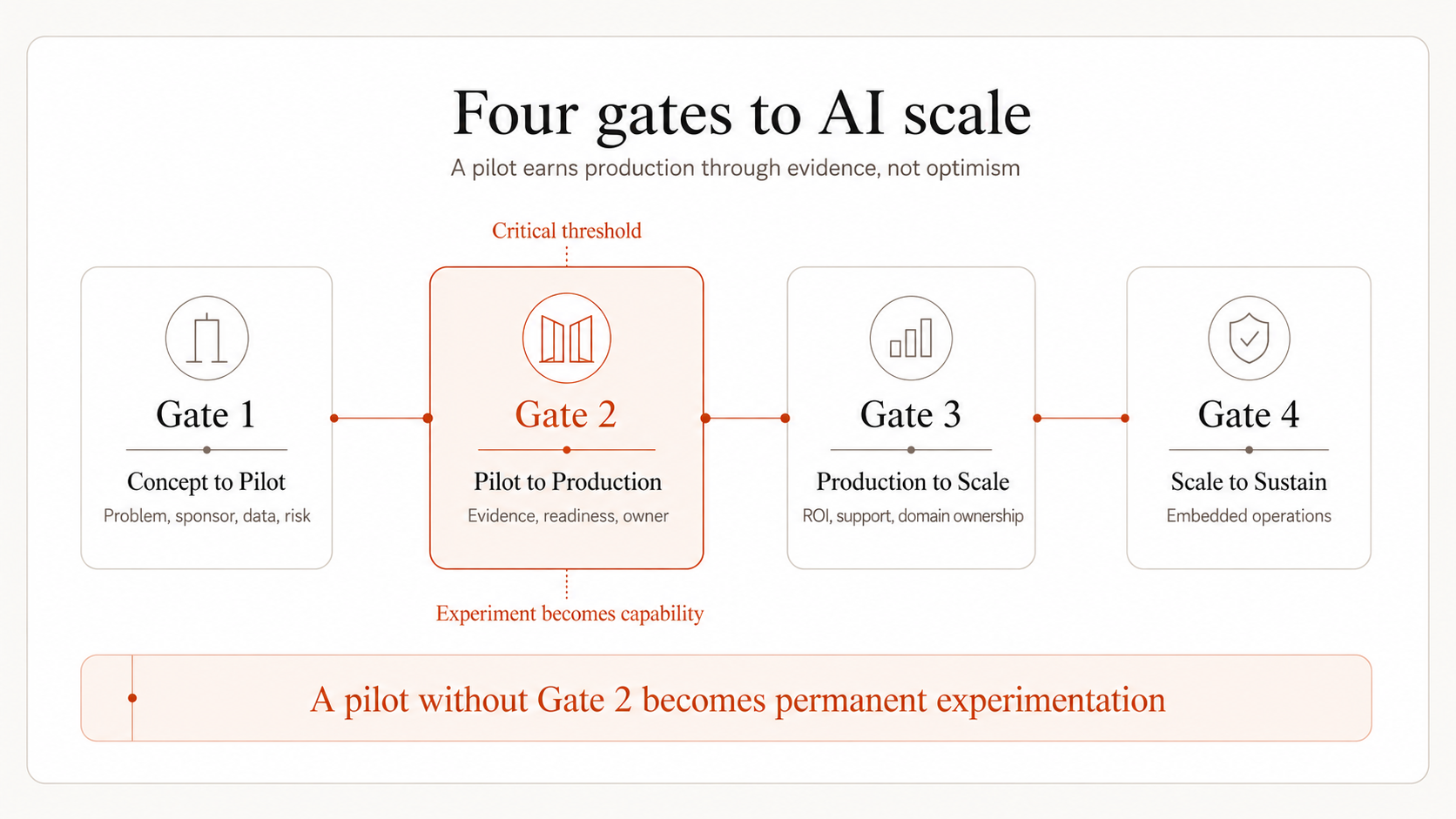
Stage gates stop AI from becoming permanent experimentation. They define what must be true before a use case receives more money, more autonomy, or wider deployment.

Gate 1: Concept to Pilot. The business problem is defined, a sponsor is named, data access is confirmed, and the risk tier is understood.

Gate 2: Pilot to Production. The pilot has met success criteria, passed readiness checks, defined monitoring and rollback, received governance sign-off, and has a named business owner.

Gate 3: Production to Scale. The use case is stable in production, the ROI case is credible, and ownership starts moving from the AI team to the business.

Gate 4: Scale to Sustain. The capability becomes part of business operations, with ownership transferred and monitoring embedded.

A pilot without Gate 2 can only become permanent experimentation.
Four-gate AI scale runway — Concept to Pilot, Pilot to Production, Production to Scale, Scale to Sustain, with Gate 2 highlighted
Gate 2 is the decisive shift from promising experiment to governed production.
Worked composite example

ArNa Assure: from scattered pilots to governed capability.

ArNa Assure is a fictional composite European insurer, not a real client and not a Foundry product. It makes the diagnostic visible.

The starting point is familiar: 12,000 employees, three business lines, six EU markets, fourteen AI pilots in eighteen months, and only two in production. Leadership has budget, ambition, and activity, but no clear operating model.

The CDO’s question is simple: “We are not short on ideas. We are short on the thing that turns a pilot into a capability.”

The diagnosis. ArNa Assure is federated by accident. Each business line has started its own pilots because the central data team cannot serve demand fast enough. Standards are fragmented, evaluation is duplicated, data access varies, and no one owns the production decision.

The target model. Hub and spoke. The centre owns platform, standards, governance, and enablement. Business lines own use case delivery and outcomes.

The first intervention is Tier 2: an AI Governance Committee with the CDO, CTO, CRO, and rotating business ownership. Its job is intake, prioritisation, Gate 2 decisions, funding allocation, and risk escalation.

The second intervention is Gate 2. No pilot moves to production without evidence, readiness, monitoring, rollback, governance sign-off, and named ownership.

The third intervention is ownership design. Central capability remains funded, but business units carry enough investment responsibility to own the outcome.

Eighteen-month trajectory. Six months: Tier 2 is operating and priority pilots have passed Gate 2 or been retired. Twelve months: three use cases are in production with named business owners. Eighteen months: hub and spoke is operating, portfolio governance is visible, and AI is managed as capability rather than activity.

The fix did not require new technology first. It required structural decisions: who decides, what evidence counts, where ownership sits, and when the business takes over.
ArNa Assure eighteen-month transformation sequence — current state, three interventions, and 6/12/18-month trajectory
The fictional composite shows how the framework moves from diagnosis to operating model design.
Start here

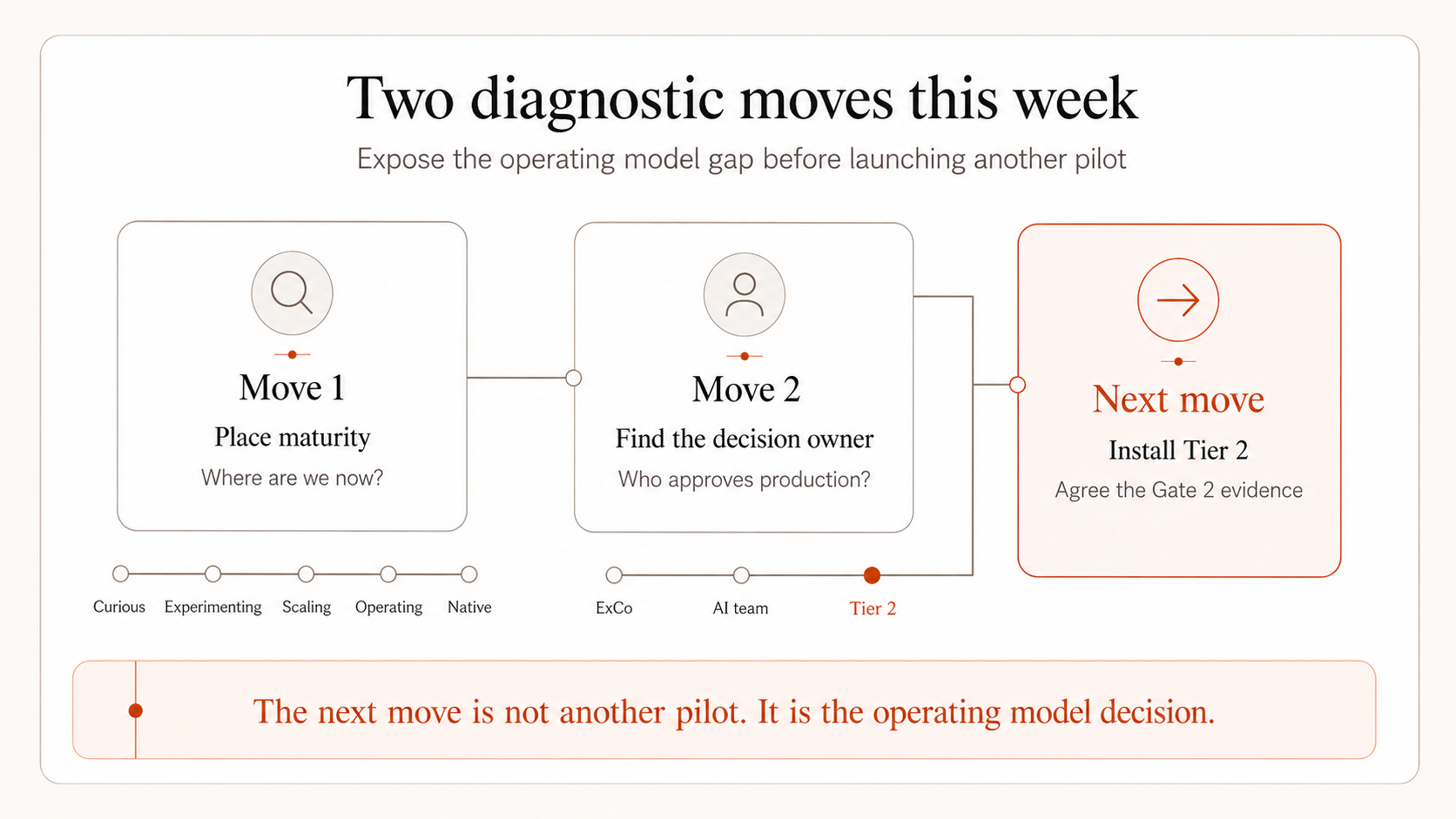
Two moves expose the operating model gap quickly.

The first move is to place the organisation on the maturity curve. Be accurate, not aspirational. Are you still experimenting, beginning to scale, or genuinely operating AI as a capability?

The second move is to ask who approves a pilot moving to production. If the answer is ExCo, the decision is probably too senior and too infrequent. If the answer is the AI team itself, the decision is probably too close to delivery. In most cases, the missing answer is Tier 2.

The next move is not another pilot. It is naming the governance body, defining the cadence, and agreeing what evidence a pilot must show before it earns production.

Two diagnostic moves this week — maturity placement and missing decision tier as immediate executive actions
Maturity placement and production-decision ownership expose the operating model gap faster than another strategy workshop.
Full PDF operating tool

Get the full AI Operating Model Design Guide.

This page is the decision aid. It helps a senior leader recognise the operating model gap and see the shape of the fix.

The full PDF is the operating tool. It contains the deeper worked example, the archetype logic, decision rights model, intake approach, Gate 2 readiness structure, funding and ownership patterns, maturity model, and failure modes a leader can work through with a CDO, CTO, Chief AI Officer, or transformation team.

Click here to get the full PDF report →

Use the report to turn the conversation from “which AI pilots do we have?” into “what operating model do we need to scale AI responsibly?”

Read alongside in the ArNaFoundry frameworks series
Framework 02
The AI Centre of Excellence Playbook
The standing organ that owns Tier 2 portfolio governance — mandate matrix, intake, scorecard, ninety-day launch plan.
Framework 03
The Pilot-to-Production Runbook
The deep treatment of Gate 2 — four-stage runway with named exit criteria, decision rights, and operational readiness.